%20(1).png)
The Worst Thing You Can Do for Low Back Pain Has Nothing to Do With Posture, Alignment, or MRI Findings
What do you think is the worst thing you can do for low back pain? Bad posture? Sitting too much? Lifting the wrong way?
None of those. Not even close.
In fact research shows these things don’t make a big difference at all.
The worst thing you can do (according to research) is to FEAR your pain.
If you like videos, here's our YouTube video on this topic:
If you like podcasts, here's our podcast on the topic:
Fear of pain is more disabling than pain itself. [1]
The fancy clinical word for this is catastrophizing, but I just call it freaking out 😅
Your brain interprets an ache or pain as a horrible emergency. Your nervous system panics. Your muscles tense up to protect, but this creates more pain.
Once that cycle starts, it becomes incredibly hard to stop.
Fear of pain has been shown to be more disabling than pain itself. [1] We literally become DISABLED due to fear.
But how does that happen?
Let’s break it down in this article:
- The good news
- What is catastrophization?
- How fear ruins your life
- What to do about it
- I know what it’s like
- Where to go from here
I'm Dr. Anthony Davis. I work with people dealing with chronic low back pain and sciatica to help them reclaim the active life they love using an evidence-based, holistic approach to rehab. Let's get into it.
First, the Good News
Most low back pain is not dangerous. That’s the first thing you need to understand.
Back pain and sciatica are almost never caused by a serious underlying disease. For most people, a flare-up improves significantly within six weeks — and while it can linger at a lower level for up to a year, that is completely normal. [2]
Quick note #1 (since I know some of you HATE the idea of “pain lingering for a year”)
- Just because pain lingers for a long time does NOT mean we have to put our lives on hold!
- We can almost always safely get people back to a normal, fulfilling life without pain ruining their lives, EVEN if they still have some residual pain and occasional “bad days.”
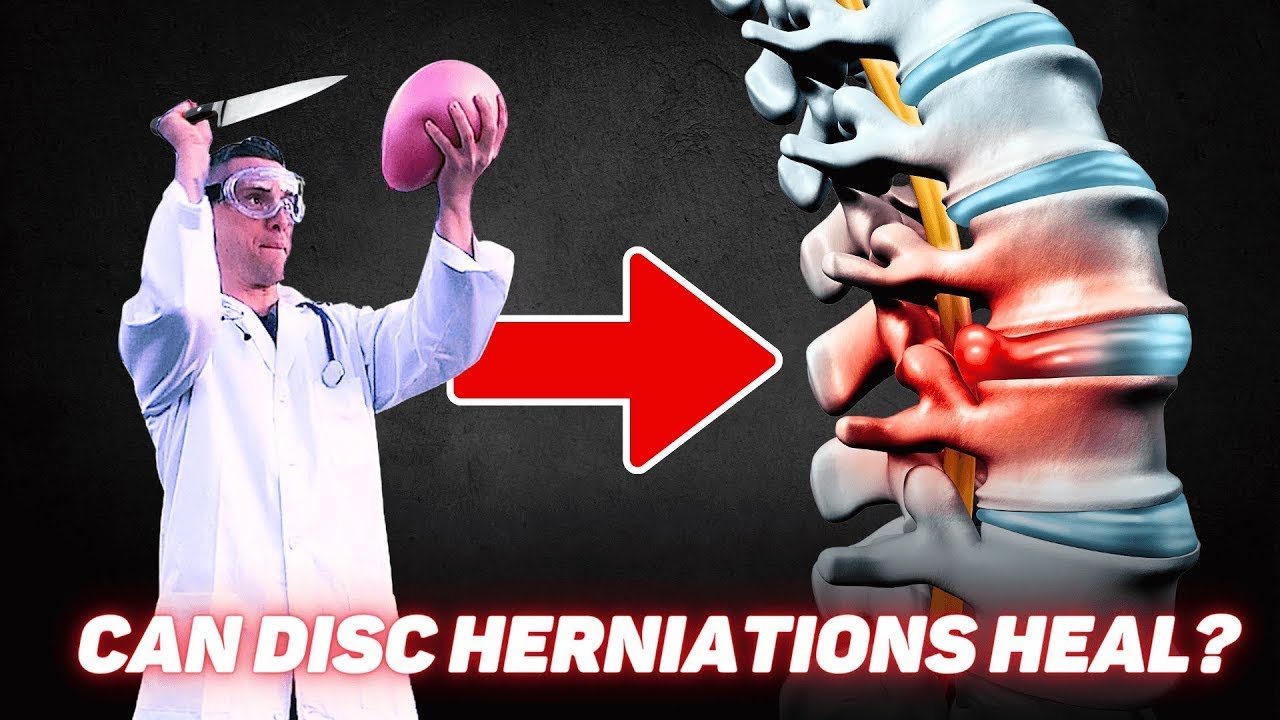
Quick note #2: Disc herniations ARE NOT SERIOUS.
- “Severe” does NOT mean “serious.”
- The majority of PAIN-FREE PEOPLE are walking around with disc herniations they don’t even know about [6]
- The worse the disc injury, the more likely it is to heal
- 96% of disc sequestrations (the most severe type of disc injury) heal on their own [11]
- Even nerve compression isn’t the end of the world
- Up to 23% of people have nerve compression with NO SYMPTOMS [9]
You don't need aggressive treatment. You don't need to panic. Time is on your side.
Massage, chiropractic, cupping, shockwave, red light, decompression and other passive therapies are fine if they help you feel better while your body does its job. Completely optional, if you don’t mind spending the money on it.
[Insert soapbox rant 😅] Please think twice before paying for decompression. The DRX-9000 machine is a waste of money. I can’t believe how many people I’ve spoken to who have been quoted up to $10,000 for 40+ sessions of decompression. This is a subject for another article, but there’s no convincing evidence for decompression, and if it DOES feel good - we can show you how to get a similar benefit at home for free. Save your money.
But the point is: most acute back pain is going to get better with or without passive therapies. The real danger is not the pain itself. It is what happens when the pain doesn't go away — when an acute episode turns into chronic pain that takes over your life.
Low back pain is the number one cause of disability on the entire planet. [2] Around 80% of people will have at least one episode in their lifetime. [3] For most, it is temporary. For some, it becomes chronic — lasting more than three months, difficult to treat, and life-altering. The question is: what separates those two groups?
In a huge part, it comes down to catastrophizing.
What Is Catastrophizing?
Catastrophizing is not weakness. It’s not drama. It’s not “all in your head.” You’re NOT making it up!
It’s a measurable, well-studied psychological pattern with three distinct components: [4]
- Magnification
- Rumination
- Helplessness
Magnification is when you make the problem seem bigger than it is.
It’s when you interpret your low back pain as a sign that something serious is wrong.
You go to “Dr. Google,” and somehow every search ends with "you might be dying."
Your nervous system is already on edge, and you just gave it nightmares. Overestimating the severity of your physical condition creates a TON of fear. And fear is not just about psychology.
Fear changes your behavior, and maladaptive behaviors worsen chronic pain.
Here’s an interesting study:
In one experiment, participants were asked to squeeze a pain-inducing ring on their own left hand using their right hand — and then had a researcher squeeze it with the exact same force. Even though the physical stimulus was identical, participants consistently rated the externally applied squeeze as more intense and more unpleasant than the one they controlled themselves. Why? Because self-generated pain is predictable, controllable, and far less threatening to your nervous system. And threatening things hurt more. [15]
The same principle applies to your back. When something feels threatening, it genuinely feels more painful. That’s not imaginary. That’s neuroscience!
Stress increases the risk of chronic pain by 180%. [5]
- How? Stress raises cortisol, tightens muscles, leads to maladaptive coping, and creates the inflammatory conditions that perpetuate pain.
- Chronic stress increases systemic inflammation due to cortisol resistance. [12]
- Psst - if you’ve ever wondered why “when it rains it pours,” and people with chronic pain or illness often have multiple overlapping health challenges, this is a big factor. Hint hint…
Rumination is when you can’t stop thinking about it.
Pain leads to fear, fear leads to stress, stress leads to more pain, which leads to more fear. We need to break the cycle.
Here are a few tips to stop the doom-loop:
- Take a breath, calm your nervous system.
- Remind yourself that your body is NOT fragile.
- Prove that gentle movement is safe and give yourself a positive experience with movement
- Try to take your mind off the pain by distracting yourself with things that bring joy into your life.
- If this is hard for you, it’s time to brainwash yourself with science! We have endless hours of videos and podcasts to re-educate you on the very optimistic picture that peer reviewed research has been painting for decades. Replace fear with facts.
And if you’re absolutely stuck, frustrated, and have no idea where to start - join our free group and reach out to learn about our Beyond Back Pain Program (or just access tons of amazing free trainings).
Helplessness is feeling like you’re doomed to live like this forever.
It’s the belief that nothing can be done — that your pain will last forever, that you are broken, that there’s no way out.
This is the most psychologically damaging part of catastrophizing, and research confirms it’s also the most strongly linked to pain severity and disability outcomes. [7]
Here is what I want you to understand: chronic pain does not mean you’re broken.
You do NOT have to live like this forever.
You just need a whole-person, comprehensive rehab approach — one that looks at your whole life, not just a tight muscle or your MRI, and holds you accountable to making the lifestyle changes necessary for long term recovery.
Oh - and this is SUPER important: Lower the bar for success!!!
- Success is NOT “I’m going to be 100% pain free forever, after only one week!
- Social media sets you up for failure with unrealistic expectations
- “ONE exercise to FIX your pain INSTANTLY!” (Sound familiar?)
- Would you be happy if:
- You could do more of the things you loved without making pain any worse?
- You could stop worrying all the time about your pain?
- You could walk a little farther?
- You could handle getting up and down off the floor to play with your kids or grandkids?
- You could find some form of exercise that doesn’t worsen your pain?
- You felt more in control of your body and mind?
I know it sounds a little silly but this is REALLY important. Lower the bar for success.
The best way to combat helplessness it to set tiny bite-sized, achievable goals, and build momentum.
Then, once you get a little dopamine hit from the excitement of hitting a small goal, you might even enjoy the process of improving your life and thinking more about what’s beyond chronic pain.
How Catastrophizing Wrecks Your Life
These three mental patterns don’t stay in your head. They drive behavior — and one of the worst maladaptive behaviors is avoidance.
You avoid doing things you think will make the pain worse. You stop lifting heavy things. You quit walking. You stop bending, twisting, doing yard work, and going to the gym. You become sedentary. [8]
This is NOT good. Sedentary life is a huge risk factor for chronic pain! The less you do, the less you’re able to do.
Then your flare-ups of pain become a self-fulfilling prophecy.
- You avoid certain activities in an effort to avoid flare-ups
- You become weaker and your capacity for physical activities lowers
- It’s easier to accidentally hurt yourself doing something simple like leaning forward brushing your teeth, or picking up a pencil
- You flare up from something simple, which makes you MORE afraid
- The cycle spirals downward, out of control
Again, let me say this loud and clear: YOU NEED TO BREAK THE CYCLE.
Taking it easy for a short window after an acute flare? Totally appropriate. The problem is when avoidance becomes the default — when the goal shifts from "I need a short break" to "I have to protect my back from all stress forever."
Here’s the problem: your body is not made to be protected from stress. It’s made to adapt to it.
Calm shit down, then build shit back up.
Most people get stuck in the “calm it down” phase and never build back up.
- Note: there is an opposite problem for “endurance copers” (people who push through pain and ignore their body’s signals), but we support those folks differently. I’m assuming if you’re reading this article you’re what we call an “avoidance coper.”
Stress can be a GOOD thing. In the right amount, followed by appropriate rest & recovery so you can adapt and become stronger.
Stress followed by recovery leads to stronger muscles, harder bones, more mobile joints. Remove the stress — depriving your back of movement for weeks or months — and you’ll get a weaker, stiffer, more fragile back. [9]
With enough time, disuse becomes disability. You were avoiding squatting because it hurt, and now you are too deconditioned to squat at all.
Squatting to pick up a grandchild… Getting up off the toilet... Standing from the floor after playing with your dog... These are basic human movements that get untrained when people stay stuck in fear for too long.
Rule Of Too’s:
Too much too fast and you get injured, but too little for too long and you become weak, which paradoxically leads to easier flare-ups and worse chronic pain.
And when disability or pain gets serious enough, depression follows. [16] Depression then makes recovery harder — motivation, exercise, sleep, nutrition, and our social lives suffer when we’re depressed. This makes pain worse, and you’re stuck in another cycle.
Not to mention this creates another feedback loop since depression increases the risk of chronic back pain by 150%. [13]
…and depression is a better predictor of future pain than your MRI findings. In fact this study found depression was the BEST predictor of chronic back pain. Period. [14]
That is the catastrophizing spiral in its full form: fear → avoidance → deconditioning → disability → depression → more fear. And it all starts with believing your back is fragile.
What You Can Do About It Right Now
So how do you break the cycle?
Step 1: If you’re genuinely freaked out about your back, rule out red flags.
Your doctor needs to rule out serious things like: [9]
- Fractures
- Malignancy
- Infections
- Cauda equina syndrome
- Typical symptoms include partial paralysis of the foot, numbness in the groin (like if you can’t feel it when wiping after using the restroom), or sudden unexplained loss of control of bowel or bladder)
MRI and other tests are fine to rule out red flags, but they don’t tell us ANYTHING useful for rehab purposes.
So if your MRI has any of these things, and you do NOT have red flags, take a breath and forget about your MRI:
These are normal findings, and usually nothing to worry about:
- Disc degeneration
- Disc bulges/herniations/protrusions/extrusions/sequestrations
- Annular fissures / annular tears
- Arthropathy
- Nerve root compression
- Stenosis (narrowing)
- Scoliosis
- Spondylolisthesis / retrolisthesis / anterolisthesis
- Fibrosis
- …and many other findings
Step 2: Re-educate yourself and replace fear-based misinformation with facts.
A great place to start is our Pain Neuroscience Miniseries.
You can access it here on YouTube.
Or you can see it inside our FREE community and gain instant access to tons of other free trainings and members-only bonus content.
The pain neuroscience mini-series will teach you what really causes chronic pain, and how it’s possible that people can have pain with or without tissue damage, and how they can have tissue damage with or without pain.
Or if you want the deep-dive, inside ALL of our paid membership tiers you’ll have access to:
- Pain science education course
- Root Cause Clarity
- Safe Pain Protocols
- Flare-up fix formula
- Daily Life Hacks & Home Pain Relief
- Guided Meditation, Breathing, & Nervous System Regulation Practices
- A personalized step-by-step program
- Individual guidance from me (Dr. Davis) & Dr. Blake
And if you want a book recommendation, we always encourage people to start with “Explain Pain” by Lorimer Mosely and David Butler.
Step 3: PROVE that movement is safe
Start easy. Be consistent. Push a tiny bit outside your comfort zone. Gradually progress.
Oh - and realize you’re still going to have some good days and bad days. That’s a NORMAL part of the process. Don’t give up because you had a bad day. That’s like pulling all your investments because the stock market dipped.
We have TONS of videos, podcasts, and resources to teach you how to do this. Some are free, some are for members of the Beyond Back Pain Program only.
Let me point out some YouTube content to start you off:
- If you’re afraid of squatting, watch this
- Here’s how to SAFELY overcome the fear of BENDING your spine
- This video debunks all the fear of bending myths you’ve been told
That said, there are a lot of questions you’ll need to answer to determine the right exercises:
How many sets/reps? Which exercises? How often? When to progress/regress/skip/modify?
If this all seems like a lot and you want us to write you a plan and hold your hand every step of the way, start by joining the FREE COMMUNITY, and it’s easy to find information about our Beyond Back Pain Program.
I know how it feels to live in fear.
I want to be real with you about something, because I’ve been there.
For years, my body felt like a prison. It felt like the source of my suffering. SI joint pain, leg pain, knee pain, neck pain, shoulder pain, hip pain, neurological symptoms, panic attacks I genuinely believed were heart attacks…
I was so afraid of my own sensations that fear poured fuel on the fire and made the symptoms 10x worse. I was caught in the catastrophizing loop, and I didn’t even have a name for it.
For me it got so bad that the only thing that numbed the pain was a handle of whiskey. I nearly died from alcohol poisoning because it was my only escape.
What changed everything for me was not a procedure, not an injection, not a surgery. It was understanding how my body actually worked — and then building the kind of lifestyle that supports a body that heals.
It was understanding that my body was NOT the source of my suffering…
My body & mind were the SOLUTION to my suffering.
Exercise. Real food. Good sleep. Working on my mental health. These simple things are incredibly powerful. These are what I now call the “The Four Pillars.”
Simple stuff that most people overlook because they are waiting for the clever external fix.
Chronic pain is multifactorial. Which means the solution has to be multifactorial too.
Sorry, but you can’t run from real lifestyle change. There’s no shortcut. There’s no magic fix.
You have to put in the work. It’s going to be uncomfortable, but that’s how you know you’re making real, lasting change.
Where to Go From Here
If you want a step-by-step plan that addresses all of this together and gives you the accountability to actually follow through — watch the Beyond Back Pain Masterclass. It’s free, it’s research-based, and it covers everything I have built over years of clinical practice and personal experience. Click here to see the free resources where we keep the Masterclass (you’ll have to join the free community to gain access).
Motion is lotion. Your back is not fragile. And the doom loop you are caught in? There IS a way out. The first obstacle we need to overcome is fear, because remember - fear is more disabling than pain itself. [1]
Disclaimer: This article is for educational purposes only and does not constitute medical advice. Consult a qualified healthcare provider before beginning any new exercise or rehabilitation program.
References
- Crombez G, Vlaeyen JW, Heuts PH, Lysens R. Pain-related fear is more disabling than pain itself: evidence on the role of pain-related fear in chronic back pain disability. Pain. 1999;80(1-2):329-339. doi:10.1016/s0304-3959(98)00229-2. PMID: 10204746. View on PubMed
- GBD 2021 Low Back Pain Collaborators. Global, regional, and national burden of low back pain, 1990-2020, its attributable risk factors, and projections to 2050: a systematic analysis of the Global Burden of Disease Study 2021. Lancet Rheumatol. 2023;5(6):e316-e329. doi:10.1016/S2665-9913(23)00098-X. PMID: 37273833. View on PubMed
- Martin BI, Tosteson ANA, Lurie JD, et al. Variation in the Care of Surgical Conditions: Spinal Stenosis: A Dartmouth Atlas of Health Care Series [Internet]. Lebanon (NH): The Dartmouth Institute for Health Policy and Clinical Practice; 2014 Oct 28. Back pain in the United States. Available from: https://www.ncbi.nlm.nih.gov/books/NBK586768/ View on PubMed
- Osman A, Barrios FX, Kopper BA, et al. Factor structure, reliability, and validity of the Pain Catastrophizing Scale. J Behav Med. 1997;20(6):589-605. doi:10.1023/A:1025570508954. PMID: 9429990. View on PubMed
- Choi S, Nah S, Jang HD, Moon JE, Han S. Association between chronic low back pain and degree of stress: a nationwide cross-sectional study. Sci Rep. 2021;11(1):14549. doi:10.1038/s41598-021-94001-1. PMID: 34267269. View on PubMed
- Brinjikji W, Luetmer PH, Comstock B, et al. Systematic literature review of imaging features of spinal degeneration in asymptomatic populations. AJNR Am J Neuroradiol. 2015;36(4):811-816. doi:10.3174/ajnr.A4173. PMID: 24620658. View on PubMed
- Burns JW, Quartana PJ, Gilliam W, et al. Rumination, magnification, and helplessness: how do different aspects of pain catastrophizing relate to pain severity and functioning? Clin J Pain. 2016;32(8):702-710. doi:10.1097/AJP.0000000000000327. PMID: 26783987. View on PubMed
- Leeuw M, Houben RM, Severeijns R, Picavet HS, Schouten EG, Vlaeyen JW. Decline in physical activity, disability and pain-related fear in sub-acute low back pain. Eur J Pain. 2005;9(4):417-425. doi:10.1016/j.ejpain.2004.09.005. PMID: 15979022. View on PubMed
- DePalma MG. Red flags of low back pain. JAAPA. 2020;33(8):8-11. doi:10.1097/01.JAA.0000684112.91641.4c View on PubMed
- Janardhana AP, Rajagopal, Rao S, Kamath A. Correlation between clinical features and magnetic resonance imaging findings in lumbar disc prolapse. Indian J Orthop. 2010;44(3):263-269. doi:10.4103/0019-5413.65148 View on Pubmed
- Chiu CC, Chuang TY, Chang KH, Wu CH, Lin PW, Hsu WY. The probability of spontaneous regression of lumbar herniated disc: a systematic review. Clin Rehabil. 2015;29(2):184-195. doi:10.1177/0269215514540919 View on PubMed
- Cohen S, Janicki-Deverts D, Doyle WJ, et al. Chronic stress, glucocorticoid receptor resistance, inflammation, and disease risk. Proc Natl Acad Sci U S A. 2012;109(16):5995-5999. doi:10.1073/pnas.1118355109 View on Pubmed
- Pinheiro MB, Ferreira ML, Refshauge K, et al. Symptoms of Depression and Risk of New Episodes of Low Back Pain: A Systematic Review and Meta-Analysis. Arthritis Care Res (Hoboken). 2015;67(11):1591-1603. doi:10.1002/acr.22619 View on Pubmed
- Jarvik JG, Hollingworth W, Heagerty PJ, Haynor DR, Boyko EJ, Deyo RA. Three-year incidence of low back pain in an initially asymptomatic cohort: clinical and imaging risk factors. Spine (Phila Pa 1976). 2005;30(13):1541-1549. doi:10.1097/01.brs.0000167536.60002.87 View on PubMed
- Wang Y, Wang JY, Luo F. Why self-induced pain feels less painful than externally generated pain: distinct brain activation patterns in self- and externally generated pain. PLoS One. 2011;6(8):e23536. doi:10.1371/journal.pone.0023536 View on Pubmed
- Bair MJ, Robinson RL, Katon W, Kroenke K. Depression and pain comorbidity: a literature review. Arch Intern Med. 2003;163(20):2433-2445. doi:10.1001/archinte.163.20.2433 View on PubMed
.jpg)