%20(1).png)
Disc Herniation Recovery Time: How Long Does It Actually Take To Heal?
Your doctor lied to you, and it's starting to piss me off.
These lies about disc herniations scare the crap out of people and push people into invasive and risky treatments that they don't need.
Yes, yes, yes, I know. Of course, sometimes in rare situations people do benefit from surgery, and I'll talk about that, but most of you don't need that.
Disc herniations HEAL. Most of them heal. The ones that don't usually don't matter.
We have decades of research clearly showing that the majority of disc injuries heal, but sadly, many healthcare providers don't keep up with research, and they just parrot the fear-mongering they learned in school. They scare the daylights out of their patients, make the pain worse, and sometimes push people into a surgery they never needed.
NOTE: For simplicity, I will use the term "disc herniation" repeatedly in this article to refer to the broad category of disc injuries which includes disc bulges, herniations, extrusions, protrusions, sequestrations, and other related injuries.
Let's look at dozens of peer-reviewed research papers on disc herniations so you can understand what to do, what to avoid, how disc herniations heal, and, most importantly, stop freaking out about your MRI.
In this article we'll cover:
- The five myths you've been told about your disc
- Whether herniations actually heal (they do)
- How long it takes, in weeks and in years
- Why your MRI says almost nothing about your pain
- What to do at home to speed things up
- When surgery is genuinely the right call
- Where to go from here
Want to watch the video instead?
Watch the full YouTube Video here:
The five myths ❌
You've probably been told some version of all five of these:
- A herniation is a serious injury
- Discs never heal
- Herniations only get worse
- Bending your spine will make it worse
- You need medications, injections, and surgery
Every one of those is wrong, but don't take my word for it. Let's look at the research!
Herniations heal. Here's the proof.
Let's start with the picture in your head. You've been told a disc is like a jelly donut. Squish it, the jelly comes out, and once it's out, it's out forever. Sounds reasonable. It's wrong.
I can't tell you how many people I speak with who still blame their bad disc for pain that flares up years down the road...
But guess what? That disc herniation you saw years ago might not even be there anymore!
Here's what actually happens. If you just leave a disc herniation alone, most of the time it will shrink or completely heal if you just give it time. [1] In this study, almost half had shrunk by more than 70%. Only 8 out of 100 people got worse. So most disc herniations get SMALLER over time, or go away completely.
Your body sees that chunk of disc as something that doesn't belong there, and it cleans it up. You don't have to do anything. Isn't the body incredible?!
What sucks is that in most anatomy classes, we are taught that cartilage does not heal, and since a disc is a type of cartilage, most people don't dig a little bit deeper. They just assume it doesn't heal because that's what they were taught in basic anatomy.
Fortunately, research paints a very optimistic picture for disc herniation recovery.
"Okay Dr. Davis, but my disc herniation is REALLY BAD! Shouldn't I be worried?"
Thanks for asking!
Here's the problem: A bigger herniation is more likely to be painful, which means it's more likely to freak you out and make you think you need surgery because it hurts like hell.
Here's the good news: A bigger herniation also gets more exposure to your blood supply and immune system, which allows your body to naturally heal and resorb that tissue.
Disc herniations come in all shapes and sizes. We could rate them from mild to scary-sounding: bulge, protrusion, extrusion, sequestration.

A sequestration is the one where a chunk breaks completely free of the disc and floats off on its own. It sounds scary, but amazingly, 96% of disc sequestrations heal on their own. [2] Extrusions, the second scariest, shrink about 70% of the time. The mild little bulges? Only 13%. The mild ones aren't sticking out far enough for your body to notice them (they don't matter anyway, we'll cover that later). The scary ones are out in the open where your body can gobble them up. And almost half of the sequestrations don't just shrink. They vanish. Gone.
I'm going to repeat that: The scariest disc herniations are the most likely to heal on their own.
Pool all the research together and about two out of three herniations heal on their own. [3] Three more studies say the same thing, including on massive ones. [4] [5] [6] That is just what discs do.
"But I don't want to sit around with debilitating pain and wait for my body to heal!"
Don't worry. You don't have to. We'll cover that at the end.
How long does it take for discs to heal and pain to go away?
This question creates the biggest problem with chronic pain rehab. Everything that's wrong with the rehab world, it seems, boils down to this frustrating question.
The entire chronic pain rehab industry and medical industrial complex and everything that's wrong with it spawns from this.
[Dramatic pause...]
Everybody wants it quick.
Everybody wants it cheap.
Everybody wants it perfect the first time.
Oh, and everybody wants a guarantee.
So before I give you the real numbers on how long it takes for this stuff to heal, I need you to take a breath, sit down, and find your inner Zen.
More practically speaking, I need you to separate two ideas in your head.
How long it takes for a disc herniation to heal is not the same as the amount of time it takes for you to get back to a normal life safely. Those are two completely different things.
Pain and anatomy are not the same thing.
Okay okay, let's rip the band-aid off. How long do I have to deal with chronic back pain or sciatica..?
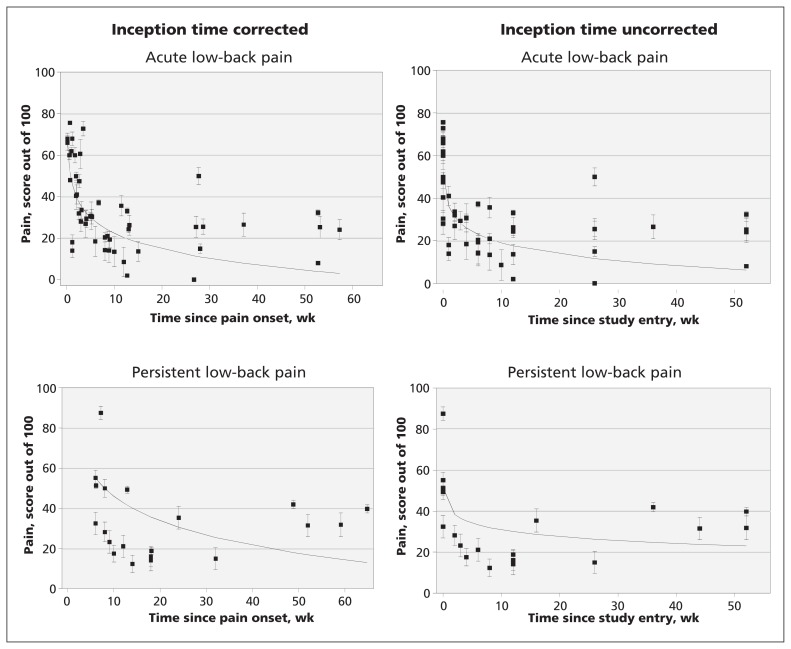
Your pain improves way faster than your disc herniation. Most of the time, symptoms settle down over a couple of months. In this study, people started at about a 5/10 pain, and by six weeks they were down to a 2/10. [7] By six months, a 1/10. By a year, most people were basically at zero. And a lot of people who were off work were back at their jobs within a month. [8]
Meanwhile, the disc itself is a slower process. That usually takes a year or two to shrink down, and sometimes longer. That's okay!
The problem is, if you keep blaming the disc herniation for the pain, you're missing the obvious fact that we learn from this research: the disc herniation does not determine whether or not you're going to have pain, or how long pain will last. If that were true, we would see that pain typically lasts for the exact same amount of time that a disc herniation lasts. Also, we would expect to see that everybody with a disc herniation has pain, which is completely untrue, and we'll cover that later.
"Okay, but I've had symptoms for way longer than a couple of months. Is my disc never going to heal?"
Remember, it's a bell curve, so some people heal faster and some people recover slower, and some people have other factors in their life that are negatively impacting their recovery. Stress, sleep, fear, doing too little for too long. Your lifestyle factors impact recovery more than the disc herniation itself. The point for right now is that a disc herniation on its own is incredibly likely to heal if you just give it time and stop freaking out about it.
Quick note #1: some of you have had pain for 5, 10, 20, or more years, and you're worried because you think your disc herniation never healed, and never will. Here are two things to consider:
- Unless you've had another MRI, you actually don't know that you still have that herniation. It may have healed, and you just don't know about it. You might just be assuming that because you still have pain, you still have a herniation, but maybe you have pain for a different reason.
- Even if your disc herniation never healed, that doesn't really matter. We'll talk about this in the next section. The short version is everybody has some stuff on their MRI, whether or not they have pain, so stop fixating on your MRI.
Quick note #2, because I know some of you are going to have a good week and then a bad week and think you're back at square one. You're not. Flare-ups are normal.
In that same study, almost three out of four people had at least one flare-up in the first year. [8] Three out of four! That's the normal path. Flare-ups are normal. In fact, they're so normal we created something we call our Flare-up Fix Formula. We made an entire mini-course for our clients in our program, specifically to coach them out of flare-ups because it happens with most people at some point, and you need to know how to deal with a flare-up. Recovery looks bumpy from the inside. A bad day is not a failure, it's just a bump on the road to recovery. If you avoid all the bumps, you never go anywhere...
.webp)
Your MRI tells you nothing about pain.
Listen up! This is the part that scares people into going under the knife.
You go to the doctor with back pain, maybe sciatica too. They order an MRI. The report comes back with a paragraph of scary words. Degeneration. Bulge. Protrusion. Nerve root contact. Stenosis...
In your head, that report becomes the explanation for everything. Every ache, every flare-up, it becomes the entire reason you can't live the life you want to live.
So it might sound crazy to you if I told you that most disc herniations do NOT cause pain.
I don't mean "most of them stop hurting eventually." I mean most of them never cause a single symptom. Only about 1 to 3 out of every 100 disc herniations ever cause symptoms. [9] The rest are just sitting there, minding their own business, in people who have no idea they exist.
How do we know that? Because researchers went and scanned over 3000 people who had ZERO back pain, and looked at what was on their MRIs. [10] Since they have zero symptoms, you'd expect that they'd have really good-looking MRI reports. They don't. Pain-free people have scary-looking MRIs. Thirty percent of pain-free 20-year-olds had a disc bulge. By age 50, it was 60%. By age 80, 84%. Same story for degeneration, protrusions, annular tears, and yes, even nerve compression. All in people with ZERO pain (or other symptoms).
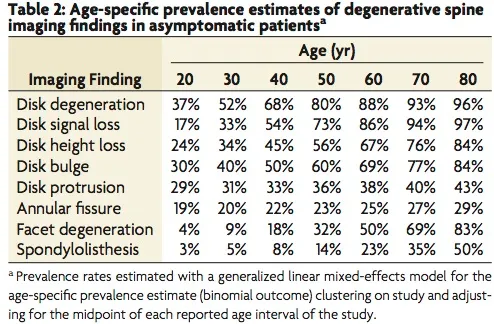
The quick rule of thumb: take your age and add 10. That's roughly the percentage of people your age walking around with a disc bulge who feel totally fine.
Most people have SOMETHING on their MRI, whether or not they have pain or any other symptoms.
So if most people with a herniation have no pain, and most people with pain get better long before the herniation changes, then what exactly is the MRI telling us about your pain?
Not much. It tells us what your spine looks like. It does NOT tell us WHY you hurt.
"But my doctor pointed right at the herniation on the screen and said THAT'S the problem."
I know. And they believe that because that's what they were taught in school. But if most pain-free people have disc herniations, then we can say with confidence that a disc herniation on its own does not guarantee that you will have pain.
Your MRI does NOT doom you to a lifetime of pain!
[Insert soapbox rant 😅] What really pisses me off is what the MRI does to you next. Getting an MRI you didn't need is not a harmless "let's just take a look." In a study of over 400,000 people, the ones who got an early MRI were between 5 and 20 times more likely to end up in back surgery. [11] What I can tell you is that the people who got scanned early ended up on the operating table a lot more often, and that pattern shows up in study after study.
An early and unnecessary MRI makes you between 5 and 20 times more likely to end up getting surgery.
An MRI is always going to show SOMETHING. A surgeon sees something to operate on, and when you're a hammer, everything's a nail.
The standard medical options are basically just a funnel that leads to surgery. Try PT. If that doesn't work, you get injections. If that doesn't work, surgery is your only option.
You've heard of a placebo. Something that does nothing, but helps because you believe it will.
A scary MRI report is the opposite. A "nocebo." It does nothing to your spine, but it makes you feel fragile and breakable, and that makes your pain worse.
And to be clear, it's not just in your head. If you're nervous about your pain and you feel fragile, you're more likely to change your behavior and avoid activities, which leads to deconditioning.
Your physical capacity for exercise and activities lowers significantly, so it's easier to hurt yourself doing basic things like putting on your shoes or picking up a pencil.
That's why, as long as your doctor has ruled out red flags (we'll cover exactly what those are in a bit), I don't care about your MRI - your disc bulge, your extrusion, your sequestration, or your degeneration. Not even a little. I care about your symptoms and what you can do. That's it.
And one last incredibly important fact: your MRI doesn't tell us anything about which exercises you should be doing or avoiding.
Two people with the same MRI respond completely differently to exercise, despite what textbooks say. Real humans are complicated, and pain is a little bit messy. The only way to know which exercises you should be doing is to assess your physical capacity and response, and gradually progress over time.
Quick note: this is not me telling you to never get an MRI. If you have red flag symptoms, get the scan. What I'm telling you is that for the other 95% of you, the scan is not going to explain your pain, and it might just scare you into a treatment you never needed. Stop rereading the report. An MRI is great at ruling out rare and serious conditions, but a disc herniation does not count as a serious condition, so stop freaking out about it.
A quick note before we keep going
If you're new here, I'm Dr. Anthony Davis. I had debilitating chronic pain for over a decade, so I know exactly what this feels like from personal experience.
In my own recovery from chronic pain, I learned the power of lifestyle changes and saw how much of an impact exercise, mental health, nutrition, and sleep had on my recovery.
Now I call these the Four Pillars, and this is the foundation of chronic pain rehab for our clients:

If at any time you'd like a structured program so you can stop guessing about which exercises to do, how to progress them, how to regulate your nervous system, and how to get back to a normal life (and you want a clear path forward back to the activities you love), check out our membership.
You can even start with a free trial:
Beyond Back Pain: Self-Guided.
Okay, let's get back to talking about disc herniations...
What should you do at home?
Here's where most people go wrong. They read everything above, they feel a little less worried, and then they ask me:
"Okay, so what's the exercise for a disc herniation?"
There isn't one. There is no magic exercise. I know that's not what you wanted to hear.
The truth is, it's literally impossible to target a single anatomical structure with an exercise. The body is too complex. Anytime you do any exercise, you're moving multiple joints, muscles, ligaments, and nerves.
There's no such thing as an exercise that is good or bad specifically for disc herniations.
Let me remind you: two people can have identical MRIs and respond differently to exercises, so exercises need to be based on the person, not the MRI.
What actually works is boring. Stay active. Try to return to life as soon as you can tolerate it, even if there's a little bit of pain. Stay social. Manage your stress. Keep moving. Give it time. Be consistent. [12]
Nothing works better than the fundamentals. Stop looking for a quick fix.
For pain relief:
Use whatever feels good. Ice, heat, a hot bath, a massage gun, whatever. None of it changes the disc, and none of it needs to. All of these things act through similar mechanisms, offering short-term pain relief. These can be used as a way to help you avoid needing medication or at least reduce your dependency on it.
Hands-on treatments like massage, chiropractic, acupuncture, dry needling, and other treatments, including decompression, are only meant for short-term pain relief. None of these things actually fix a disc herniation, despite what people selling you $10,000 packages of spinal decompression will claim.
What about hands-on treatment? If chiropractic, acupuncture, or massage make your day better, go get them. They're optional. They don't speed up recovery compared to exercise on its own. [15] But if it feels good and you don't mind paying for it, enjoy it. Just for the love of god, don't let anybody tell you your alignment is off, your leg is short, or your curvature is wrong. None of that stuff is true, and I've got a pile of videos debunking every one of those myths.
I repeat, spinal decompression does not fix disc herniations!
If it feels good, go for it, but don't spend a lot of money on it. There are free ways to do this at home that are just as effective.
If you want a simple home decompression practice, this one is one of my favorites, but remember, it should feel good. If it does not feel good, skip it and do something else:
For exercise:
Do the hardest thing you can tolerate with mild or moderate pain, as long as it doesn't leave you significantly worse the next day. If it does, back off a little. Then slowly ramp back up. Calm shit down, then build shit back up.
"But how do I know if the pain during exercise is okay or if I'm hurting myself?"
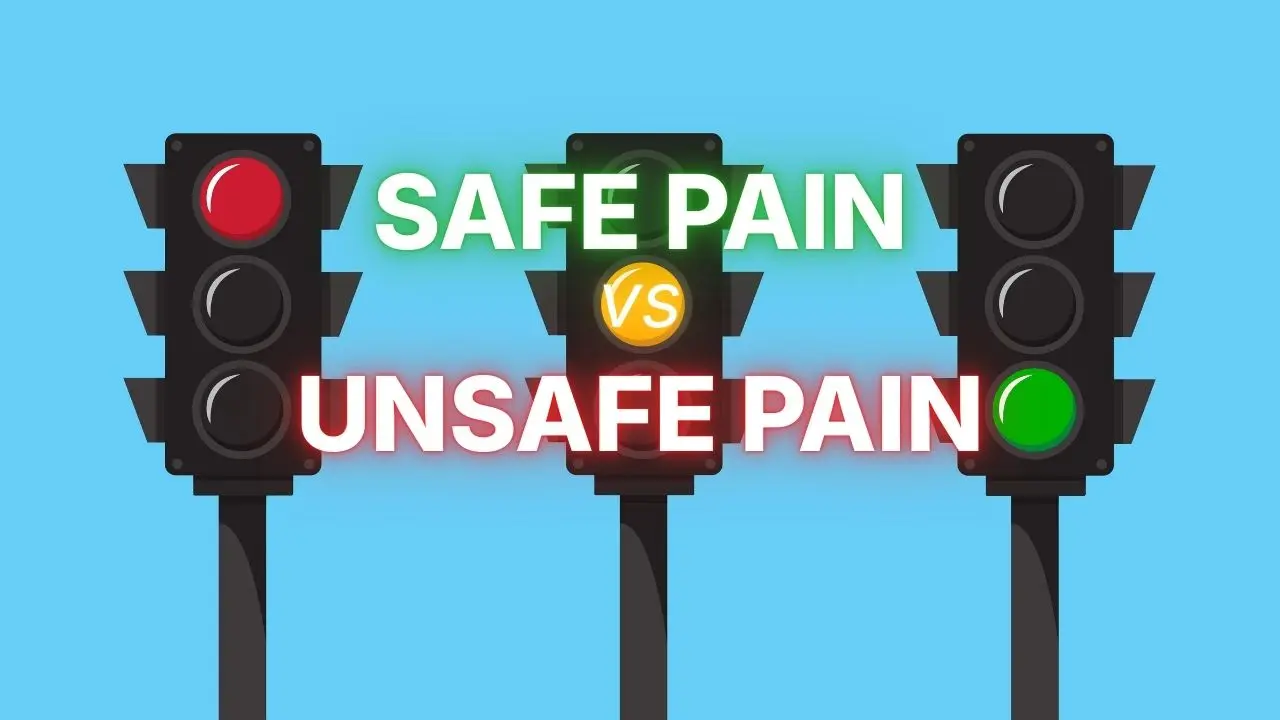
Great question, and honestly it's the thing we spend the most coaching time on with our clients. We call it our Safe Pain Protocols. The short version is a traffic light. Green light pain, a 1 to 3 out of 10, keep going. Yellow, 4 to 6, slow down. Red, 7 or above, stop and do something else. Then check the next day: are you worse? If not, you're fine.
Here's a condensed version of the Safe Pain Protocols that we use with our clients:
How hard should my exercises be?
Now, the mistake I see over and over: the Rule of Too's.
Too much too fast gets you hurt.
Too little for too long gets you weak.
Most people are scared of pushing too fast, so instead they avoid activities because they don't want to make it worse and re-injure themselves.
But this leads to deconditioning and atrophy, and because your body is weak and you've lost your physical capacity, you can hurt yourself just doing basic things.
It's a self-fulfilling prophecy.
Typically, this leads to what I call "rehab purgatory."
That's where you spend month after month chasing your posture, your alignment, your pelvic tilt, and your core stability, and going nowhere.
Guess what happened when they compared core stability exercises against plain general exercise? Although core stability showed some benefits short-term with severe pain, we see that long-term, general exercise is just as effective. [13] Core stability has a time and a place, but there are some major drawbacks to emphasizing core stability too much because it results in fear of movement, which leads to excessive muscle guarding and ultimately more pain long term.
Another great option is just walking and slowly increasing the amount that you walk.
Research shows that for some people, walking can be just as effective as some other forms of exercise. [14] And the good thing about walking is it's free, and it's easy to track linear progress and scale gradually over time.
A lot of people are afraid of bending their spine during exercise. Let's bust that myth right now.
Most people believe the typical dogma that we would hear from people like Stuart McGill that bending forward increases the size of a disc herniation and bending is bad.
Researchers have taken MRIs of people's spines while they're bending forward and bending backwards, and in some cases the disc herniation shrinks when they bend backwards, which is the opposite of what most people have been told. [16] Bending is not the villain. Your spine has a dozen joints in it because it's supposed to move.
We made a full video just to bust the myth of being afraid of bending your spine. If you want to watch that, we cite a lot more studies in this video:
Stop blaming the disc herniation for your pain.
Back pain is the number one cause of disability on the planet, and it is multifactorial. [17] That's a fancy word for "a lot of things add up." Sleep, stress, mood, alcohol, and what you eat all show up in the research. [18]
For example, depression is actually a stronger predictor of back pain than your MRI findings.
In this study, they took a group of people with NO back pain, scanned them, and then waited three years to see who developed pain. [19] The strongest predictor of who ended up with back pain was not what was on the MRI. It was depression.
My impression of these studies is not to say that pain is all in your head or that it's just about your thoughts, but that our mental health impacts our behaviors, our lifestyle, and our choices. Those maladaptive life changes make it likely to develop back pain.
I want to be really clear. I'm not saying that pain is in your head. In fact, I'm not saying that pain is due to one specific thing versus the other thing. I'm not even discounting the fact that disc herniations can be one piece of the puzzle. I'm trying to get you to zoom out and realize that there are always multiple factors influencing pain. Instead of worrying about the things that are out of your control, let's focus on the things that you can control, like exercise, mental health, nutrition, and sleep.
Pain is multifactorial

Stop trying to blame one thing for your pain.
That's literally impossible.
Sure, the disc herniation and your MRI findings might be a couple of drops in the bucket, but we can work around those!
As long as there are no red flags, or if your doctor took a history, did an exam, and sent you to PT, then you've got nothing to worry about.
- Focus on the things that you can control.
- Focus on gradual exposure to full-body mobility and strength.
- Focus on reducing your stress, your fear, your depression, and your worry.
- Take your mind off of chronic pain.
- Forget about your MRI.
- Focus on improving your quality of life, even if you still have some pain.
When surgery is a real consideration
Some situations need a surgeon. If you're ever worried, get THREE different surgical opinions if possible.
Cauda equina syndrome. That's severe compression of the nerves in the spinal canal, and it is an emergency. Tell your doctor immediately if you get numbness through the inner thighs and groin (like you can't feel it when you wipe after using the restroom), or if you lose control of your bowels or bladder. Watch out for foot drop or your legs giving out on you. [20] Fortunately, this is rare. Somewhere between 0.3 and 7 people out of every 100,000 per year. [21]
Progressing motor deficits. Rapid strength loss, foot drop, can't wiggle your toes, a calf that's visibly shrinking... Significant weakness usually isn't an emergency, and most of the time you have room to try rehab first. But if a leg is measurably shrinking and getting weaker, get a surgical consult. Or if you suddenly wake up one day and you can't move your foot, talk to your doctor immediately. [22]
The good news is that, as long as your doctor does a proper exam with these symptoms, even things like foot drop and a bit of incontinence or leakage can often reverse themselves over time with a proper rehab program. Obviously, it's critical to monitor these symptoms closely in case it becomes an emergency, but we've worked with many cases of foot drop and many of our clients have reversed their foot drop. Usually, your doctor will tell you if it's okay to pursue non-surgical options.
Severe pain, on its own, is not a red flag. It sucks, but it's common, and it usually resolves with good rehab + time.
"Okay, but if I don't have red flags, wouldn't surgery just get me there faster?"
Faster, maybe. Further, no. Plus surgery is expensive and risky.
In these studies, people who had surgery and people who did conservative care landed at about the same pain and function by 6 to 12 months. [23] [24] The surgery group got relief sooner, but long term there was no difference.
Is surgery a placebo?
This one is wild: after a FAKE spine procedure, where they did nothing to the spine at all, about half the patients had a significant drop in pain. [25] Half. From a fake surgery.
If you're considering a spinal fusion, please do yourself a favor and get a minimum of three different surgeons' opinions first.
Spinal fusion is a severe, intensive surgery with major long-term risks. If you fuse one region, people typically get what we call "adjacent segment disease," where the segment above or below the fusion gets excessive wear and tear and needs to be fused later, so you end up having repeat fusions. About 1 in 5 fusion patients needed another operation over the following decade. [26] Fusion gets about the same result as conservative care. [27] It typically costs somewhere around $22,000, and can run past $70,000. [28] And it comes with real risks, like infection and blood clots. [29] So the riskiest, most expensive surgery you can get doesn't even get better results than conservative care.
Nerve ablation:
They burn the nerve. This can have some pain relieving effects for facet joint pain and SI joint pain. For disc pain specifically, the evidence is mixed. [30] And I don't know about you, but "mixed" is not enough for me to let somebody burn my nerves off. Oh, and after ablation, oftentimes we see neuronal sprouting where the nerves just regrow and are more painful.
Medications:
Opioids are linked to worse pain and disability down the road, plus the addiction risk. [31] NSAIDs are a reasonable backup if your doctor is okay with it (heart or stomach issues change that). Muscle relaxers and oral steroids aren't recommended at all. [12] Steroid injections might buy you short-term relief. [32] I'll be straight with you, though: I've worked with a lot of people who felt WAY worse after an injection, so personally, I'd skip it.
What if I already had surgery?
Quick note, because I know some of you already had the surgery and you're reading this regretting that decision: you didn't do anything wrong. You did what you were told with the information you had. And everything in this article still applies to you. The lifestyle that got you into that situation is still the thing to fix, surgery or no surgery.
Just move on and focus on the things you can control. We've worked with tons of people who have had previous microdiscectomies, laminectomies, and fusions, and gotten them back to the active life that they were missing out on.
I've been on your side of this
For years my body felt like a prison I needed to escape from. SI joint pain, leg pain, neck pain, panic attacks I was sure were heart attacks. I nearly died from alcohol poisoning because drinking was the only thing that turned the volume down.
What finally turned it around was understanding how my body actually worked, and learning how to take care of it. My body turned out to be the solution, not the problem.
Your symptoms are real. Even when the cause isn't structural, your symptoms are still real. Nobody gets to tell you it's in your head.
Where to go from here
Here's what all of that research points to.
Your herniation will most likely shrink or disappear over a year or two, and the scarier it looks, the better your chances of healing.
Your pain will probably settle in a few months, long before the MRI & disc changes.
And if the herniation never fully goes away, that's fine, because most people are walking around with one and don't even know it.
Motion is lotion. Conservative care gets just as good of results as invasive and risky procedures, without the cost or risk.
So start with the boring version. Go for a walk today. Start with easy exercises testing all of your major muscle groups and joints, then add a little bit at a time and gradually progress. Sleep. Handle your stress. And stop rereading your MRI report.
If you want the whole thing laid out for you, our Beyond Back Pain program will tell you exactly what to do, what to avoid, and give you the accountability and support that you need to get back to an active life.
Start your free trial: Beyond Back Pain: Self-Guided.
References
1. Bozzao A, Gallucci M, Masciocchi C, Aprile I, Barile A, Passariello R. Lumbar disk herniation: MR imaging assessment of natural history in patients treated without surgery. Radiology. 1992;185(1):135-141. doi:10.1148/radiology.185.1.1523297. PMID: 1523297. View on PubMed
2. Chiu CC, Chuang TY, Chang KH, Wu CH, Lin PW, Hsu WY. The probability of spontaneous regression of lumbar herniated disc: a systematic review. Clin Rehabil. 2015;29(2):184-195. doi:10.1177/0269215514540919. PMID: 25009200. View on PubMed
3. Zhong M, Liu JT, Jiang H, Mo W, Yu PF, Li XC, Xue RR. Incidence of spontaneous resorption of lumbar disc herniation: a meta-analysis. Pain Physician. 2017;20(1):E45-E52. PMID: 28072796. View on PubMed
4. Benson RT, Tavares SP, Robertson SC, Sharp R, Marshall RW. Conservatively treated massive prolapsed discs: a 7-year follow-up. Ann R Coll Surg Engl. 2010;92(2):147-153. doi:10.1308/003588410X12518836438840. PMID: 19887021. View on PubMed
5. Ahn SH, Ahn MW, Byun WM. Effect of the transligamentous extension of lumbar disc herniations on their regression and the clinical outcome of sciatica. Spine (Phila Pa 1976). 2000;25(4):475-480. doi:10.1097/00007632-200002150-00014. PMID: 10707394. View on PubMed
6. Altun I, Yuksel KZ. Lumbar herniated disc: spontaneous regression. Korean J Pain. 2017;30(1):44-50. doi:10.3344/kjp.2017.30.1.44. PMID: 28119770. View on PubMed
7. da C Menezes Costa L, Maher CG, Hancock MJ, McAuley JH, Herbert RD, Costa LO. The prognosis of acute and persistent low-back pain: a meta-analysis. CMAJ. 2012;184(11):E613-E624. doi:10.1503/cmaj.111271. PMID: 22586331. View on PubMed
8. Pengel LH, Herbert RD, Maher CG, Refshauge KM. Acute low back pain: systematic review of its prognosis. BMJ. 2003;327(7410):323. doi:10.1136/bmj.327.7410.323. PMID: 12907487. View on PubMed
9. Jordan J, Konstantinou K, O'Dowd J. Herniated lumbar disc. BMJ Clin Evid. 2009;2009:1118. PMID: 19445754. View on PubMed
10. Brinjikji W, Luetmer PH, Comstock B, et al. Systematic literature review of imaging features of spinal degeneration in asymptomatic populations. AJNR Am J Neuroradiol. 2015;36(4):811-816. doi:10.3174/ajnr.A4173. PMID: 25430861. View on PubMed
11. Jacobs JC, Jarvik JG, Chou R, Boothroyd D, Lo J, Nevedal A, Barnett PG. Observational study of the downstream consequences of inappropriate MRI of the lumbar spine. J Gen Intern Med. 2020;35(12):3605-3612. doi:10.1007/s11606-020-06181-7. PMID: 32989711. View on PubMed
12. Foster NE, Anema JR, Cherkin D, et al. Prevention and treatment of low back pain: evidence, challenges, and promising directions. Lancet. 2018;391(10137):2368-2383. doi:10.1016/S0140-6736(18)30489-6. PMID: 29573872. View on PubMed
13. Coulombe BJ, Games KE, Neil ER, Eberman LE. Core stability exercise versus general exercise for chronic low back pain. J Athl Train. 2017;52(1):71-72. doi:10.4085/1062-6050-51.11.16. PMID: 27849389. View on PubMed
14. Vanti C, Andreatta S, Borghi S, Guccione AA, Pillastrini P, Bertozzi L. The effectiveness of walking versus exercise on pain and function in chronic low back pain: a systematic review and meta-analysis of randomized trials. Disabil Rehabil. 2019;41(6):622-632. doi:10.1080/09638288.2017.1410730. PMID: 29207885. View on PubMed
15. Gomes-Neto M, Lopes JM, Conceicao CS, et al. Stabilization exercise compared to general exercises or manual therapy for the management of low back pain: a systematic review and meta-analysis. Phys Ther Sport. 2017;23:136-142. doi:10.1016/j.ptsp.2016.08.004. PMID: 27707631. View on PubMed
16. Alyas F, Connell D, Saifuddin A. Upright positional MRI of the lumbar spine. Clin Radiol. 2008;63(9):1035-1048. doi:10.1016/j.crad.2007.11.022. PMID: 18718234. View on PubMed
17. Hartvigsen J, Hancock MJ, Kongsted A, et al. What low back pain is and why we need to pay attention. Lancet. 2018;391(10137):2356-2367. doi:10.1016/S0140-6736(18)30480-X. PMID: 29573870. View on PubMed
18. Liu S, Lv X, Deng X, Lai R, Du J, Wang C. Diet and risk of low back pain: a Mendelian randomization analysis. Eur Spine J. 2024;33(2):496-504. doi:10.1007/s00586-023-07970-4. PMID: 37934267. View on PubMed
19. Jarvik JG, Hollingworth W, Heagerty PJ, Haynor DR, Boyko EJ, Deyo RA. Three-year incidence of low back pain in an initially asymptomatic cohort: clinical and imaging risk factors. Spine (Phila Pa 1976). 2005;30(13):1541-1548, discussion 1549. doi:10.1097/01.brs.0000167536.60002.87. PMID: 15990670. View on PubMed
20. Spector LR, Madigan L, Rhyne A, Darden B, Kim D. Cauda equina syndrome. J Am Acad Orthop Surg. 2008;16(8):471-479. doi:10.5435/00124635-200808000-00006. PMID: 18664636. View on PubMed
21. Hoeritzauer I, Wood M, Copley PC, Demetriades AK, Woodfield J. What is the incidence of cauda equina syndrome? A systematic review. J Neurosurg Spine. 2020;32(6):832-841. doi:10.3171/2019.12.SPINE19839. PMID: 32059184. View on PubMed
22. Yoon WW, Koch J. Herniated discs: when is surgery necessary? EFORT Open Rev. 2021;6(6):526-530. doi:10.1302/2058-5241.6.210020. PMID: 34267943. View on PubMed
23. Chou R, Baisden J, Carragee EJ, Resnick DK, Shaffer WO, Loeser JD. Surgery for low back pain: a review of the evidence for an American Pain Society clinical practice guideline. Spine (Phila Pa 1976). 2009;34(10):1094-1109. doi:10.1097/BRS.0b013e3181a105fc. PMID: 19363455. View on PubMed
24. Peul WC, van den Hout WB, Brand R, Thomeer RT, Koes BW. Prolonged conservative care versus early surgery in patients with sciatica caused by lumbar disc herniation: two year results of a randomised controlled trial. BMJ. 2008;336(7657):1355-1358. doi:10.1136/bmj.a143. PMID: 18502911. View on PubMed
25. Jamjoom AM, Saeedi RJ, Jamjoom AB. Placebo effect of sham spine procedures in chronic low back pain: a systematic review. J Pain Res. 2021;14:3057-3065. doi:10.2147/JPR.S317697. PMID: 34616178. View on PubMed
26. Martin BI, Mirza SK, Comstock BA, Gray DT, Kreuter W, Deyo RA. Reoperation rates following lumbar spine surgery and the influence of spinal fusion procedures. Spine (Phila Pa 1976). 2007;32(3):382-387. doi:10.1097/01.brs.0000254104.55716.46. PMID: 17268274. View on PubMed
27. Saltychev M, Eskola M, Laimi K. Lumbar fusion compared with conservative treatment in patients with chronic low back pain: a meta-analysis. Int J Rehabil Res. 2014;37(1):2-8. doi:10.1097/MRR.0b013e328363ba4b. PMID: 23820296. View on PubMed
28. Beckerman D, Esparza M, Lee SI, et al. Cost analysis of single-level lumbar fusions. Global Spine J. 2020;10(1):39-46. doi:10.1177/2192568219853251. PMID: 32002348. View on PubMed
29. Ondeck NT, Bohl DD, Bovonratwet P, et al. Adverse events following posterior lumbar fusion: a comparison of spine surgeons' perceptions and reported data for rates and risk factors. Int J Spine Surg. 2018;12(5):603-610. doi:10.14444/5074. PMID: 30364864. View on PubMed
30. Leggett LE, Soril LJ, Lorenzetti DL, et al. Radiofrequency ablation for chronic low back pain: a systematic review of randomized controlled trials. Pain Res Manag. 2014;19(5):e146-e153. doi:10.1155/2014/834369. PMID: 25068973. View on PubMed
31. Franklin GM, Stover BD, Turner JA, Fulton-Kehoe D, Wickizer TM. Early opioid prescription and subsequent disability among workers with back injuries: the Disability Risk Identification Study Cohort. Spine (Phila Pa 1976). 2008;33(2):199-204. doi:10.1097/BRS.0b013e318160455c. PMID: 18197107. View on PubMed
32. Huang R, Meng Z, Cao Y, et al. Nonsurgical medical treatment in the management of pain due to lumbar disc prolapse: a network meta-analysis. Semin Arthritis Rheum. 2019;49(2):303-313. doi:10.1016/j.semarthrit.2019.02.012. PMID: 30940466. View on PubMed
This article is for educational purposes only and does not constitute medical advice. Always consult a qualified healthcare provider before making changes to your treatment plan.
.jpg)